Frequently Asked Questions
Real answers to the most common questions about IBC totes, recycling, grading, food safety, pricing, and more.
Get a Free Quote
We respond within 24 hours
Frequently Asked Questions
General
5 questionsQ1.What exactly is an IBC tote?
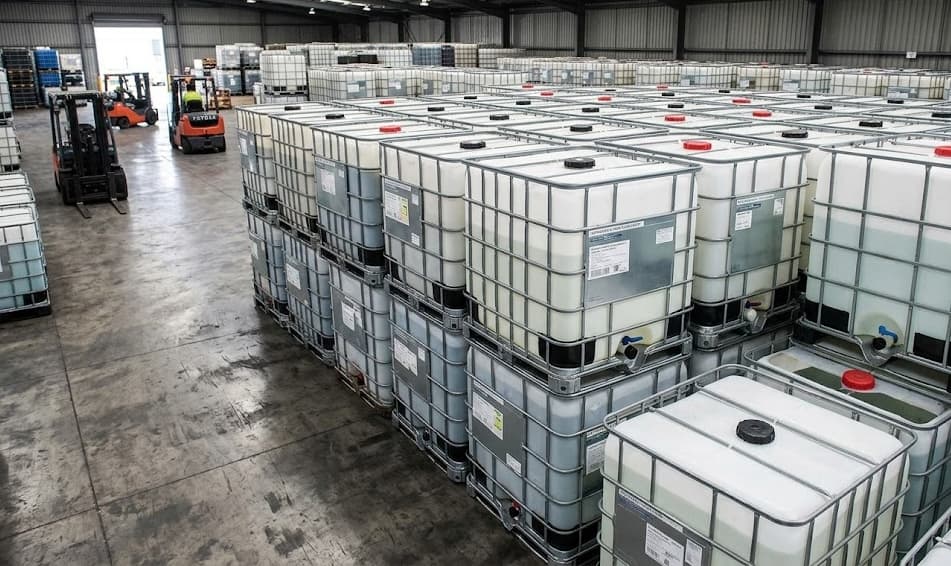
An IBC (Intermediate Bulk Container) tote is a reusable industrial container engineered for the storage and transportation of bulk liquids, pastes, and granulated materials. The most widely used design is the composite IBC, which pairs an HDPE (High-Density Polyethylene) blow-molded inner bottle with a galvanized tubular steel cage, all mounted on a pallet base for forklift handling. Standard capacities are 275 gallons (approximately 1,040 liters) and 330 gallons (approximately 1,250 liters). IBCs are employed across dozens of industries, from food and beverage processing to chemical manufacturing, agriculture, pharmaceuticals, water treatment, and cosmetics. They effectively bridge the gap between 55-gallon drums and full-size tanker trucks, offering a cost-efficient, space-efficient, and logistically practical bulk packaging solution.
Q2.What is the difference between a 275-gallon and a 330-gallon IBC tote?
Both the 275-gallon and 330-gallon IBC totes share the same standard 48-inch by 40-inch pallet footprint, which means they fit into the same warehouse racking systems, truck configurations, and floor layouts without any modification. The 330-gallon model is approximately 7 inches taller, providing roughly 20 percent more liquid capacity. If your facility can accommodate the additional height and your application benefits from larger batch sizes, the 330-gallon model delivers better value per gallon stored. Conversely, the 275-gallon model is preferred when ceiling height is limited, when weight restrictions apply to your racking or floor load capacity, or when the smaller volume better aligns with your production batch requirements. Both sizes are available in all grades and configurations at IBC Recycling Chicago.
Q3.What are IBC totes made of?
The most common IBC totes — composite IBCs — are constructed from three primary materials. The inner bottle is blow-molded from HDPE (High-Density Polyethylene), a food-safe, chemically resistant thermoplastic that can handle most acids, bases, and solvents. The surrounding cage is fabricated from galvanized tubular carbon steel, welded at each intersection point for maximum structural rigidity and corrosion protection. The pallet base may be wood (heat-treated to ISPM-15 standards), HDPE plastic (preferred for food and pharmaceutical applications due to its hygienic, non-absorbent surface), or galvanized steel (the most durable option, standard on metal IBCs). Specialty IBCs are also available entirely in stainless steel (304 or 316 grade) for aggressive chemical environments and high-temperature applications.
Q4.What industries use IBC totes most commonly?
IBC totes are used across a remarkably broad range of industries. Chemical manufacturers use them for acids, solvents, and industrial cleaning agents. Food and beverage processors store everything from fruit juice concentrates and cooking oils to liquid sweeteners and wine in food-grade IBCs. Agricultural operations rely on them for fertilizers, pesticides, and herbicides. The pharmaceutical and cosmetic industries use stainless steel or food-grade composite IBCs for active ingredients, lotions, and fragrances. Water treatment facilities store treatment chemicals and purified water in IBCs. Automotive and petroleum companies use them for lubricants, coolants, and waste oil. Even the construction industry uses IBCs for concrete sealers, adhesives, and paint products. Their universal pallet footprint and forklift compatibility make them practical in virtually any industrial or commercial setting.
Q5.How much does a full IBC tote weigh?
An empty composite IBC tote weighs between 120 and 145 pounds depending on the pallet material (wood, plastic, or steel) and the specific manufacturer. When filled with water, a 275-gallon IBC weighs approximately 2,420 pounds (275 gallons times 8.34 lbs per gallon plus the tote weight), while a 330-gallon IBC weighs approximately 2,890 pounds. If you are storing denser liquids such as chemicals or syrups, the weight will be significantly higher — always check the specific gravity of your product and confirm that your racking, floor, and handling equipment are rated for the loaded weight. Stainless steel IBCs weigh considerably more when empty, ranging from 200 to over 500 pounds depending on capacity and wall thickness.
Buying
5 questionsQ6.What are the different grades of used IBC totes?
Used IBC totes are classified into three quality grades at IBC Recycling Chicago. Grade A totes are in excellent condition with minimal cosmetic wear, clean interiors, intact labels, fully functional valves, and no structural issues — they are ideal for food-grade, pharmaceutical, and sensitive chemical applications. Grade B totes show moderate cosmetic wear including scuffs, surface stains, minor dents in the cage, or slight discoloration of the bottle, but remain structurally sound and leak-free — they are well-suited for industrial chemicals, agricultural products, and general storage. Grade C totes exhibit more significant cosmetic damage such as heavy staining, larger cage dents, worn labels, or visible bottle discoloration — they are best for non-critical applications like rainwater collection, garden irrigation, livestock watering, and non-potable water storage. Every tote at every grade is inspected for structural integrity and confirmed leak-free before sale.
Q7.How much do used IBC totes cost?
Pricing for used IBC totes varies based on grade, size, condition, and current market supply. As a general guideline, used Grade A 275-gallon IBC totes typically range from $100 to $200, Grade B totes from $60 to $120, and Grade C totes from $30 to $75. The 330-gallon models usually carry a $20 to $40 premium over equivalent 275-gallon totes. Reconditioned IBCs (with brand-new HDPE bottles installed in existing cages) range from $150 to $275, while brand-new IBCs from manufacturers cost $300 to $500 or more. Volume discounts are available for orders of 10 or more units. Because pricing fluctuates with supply and demand throughout the year, we recommend contacting us at info@ibcrecyclingchicago.com for a current quote tailored to your specific needs.
Q8.Is there a minimum order quantity for buying IBC totes?
No, there is no minimum order at IBC Recycling Chicago. We are happy to sell a single tote to a homeowner who needs a rain barrel, or a full truckload of 80 units to a manufacturing plant scaling up operations. That said, purchasing in volume does unlock significant per-unit savings and reduced delivery costs. Orders of 10 or more units qualify for our standard volume discount, and orders of a full truckload (typically 56 to 80 empty totes, depending on size) receive our best pricing along with free local delivery within 50 miles of our Elk Grove Village facility. Whether you need one tote or one hundred, reach out and we will put together the most cost-effective package for your situation.
Q9.Do you offer delivery for purchased IBC totes?
Yes, we provide comprehensive delivery services throughout the Chicagoland area and the greater Midwest region. Local deliveries within 50 miles of our Elk Grove Village facility are typically available same-day or next-day, and are free for full-truckload orders. Regional deliveries to destinations across Illinois, Indiana, Wisconsin, Iowa, Michigan, and surrounding states are scheduled on a weekly basis using our flatbed trucks, which can carry up to 80 empty IBCs or approximately 20 filled IBCs per load. For smaller orders or customers beyond our regular delivery routes, we can arrange cost-effective third-party freight. We also welcome customer pickup at our facility during business hours — simply call or email ahead so we can have your order ready for loading when you arrive.
Q10.Can I see the IBC totes before purchasing?
Absolutely. We encourage customers to visit our Elk Grove Village facility to inspect inventory before purchasing, especially for large orders or specific application requirements. You can see our current stock of Grade A, B, and C totes in person, check valve and lid conditions, examine bottle clarity and cage integrity, and choose the exact units you want. We are open Monday through Friday during business hours and can accommodate Saturday visits by appointment. If an in-person visit is not practical, we are happy to send detailed photos and videos of available inventory, including close-ups of any areas of interest such as labels, valves, or cage welds. Contact us to schedule a visit or request photos at info@ibcrecyclingchicago.com.
Selling
4 questionsQ11.Do you buy used IBC totes? How much do you pay?
Yes, we actively purchase used IBC totes in any condition — from pristine food-grade units to heavily worn industrial containers. Payout depends on the tote grade, age (based on the UN date stamp), previous contents, and quantity. Clean, recent-manufacture, food-grade totes command the highest per-unit price, while older or heavily damaged totes still have value through our recycling program. We also offer free pickup for quantities of 20 or more units within the greater Chicagoland area, which means zero out-of-pocket cost to liquidate your surplus inventory. For smaller quantities or locations farther away, we can arrange cost-effective pickup. Email us at info@ibcrecyclingchicago.com with photos, approximate quantities, and your location for a fast quote — most quotes are returned within 24 hours.
Q12.What condition do IBC totes need to be in for you to buy them?
We buy IBC totes in virtually any condition. Pristine food-grade totes with clear bottles and clean interiors bring the highest value. Standard used totes with moderate wear, staining, or minor cage damage are purchased at standard rates. Even heavily damaged totes with cracked bottles, bent cages, broken valves, or missing pallets have recycling value — we break these down and recycle each material stream separately (HDPE to plastic recyclers, steel to metal recyclers). The only IBCs we cannot accept are those that contained certain extremely hazardous materials (such as radioactive substances or PCBs) that require specialized disposal. If you are unsure whether we can take your totes, send us photos and a description of previous contents and we will let you know immediately.
Q13.How does the IBC tote pickup process work?
The process is straightforward and designed to be hassle-free. First, contact us with details about your totes — quantity, approximate condition, previous contents (if known), and your location. We will provide a per-unit price quote, typically within 24 hours. Once you accept the quote, we schedule a pickup at a date and time convenient for you. Our truck arrives, our crew loads the totes (you do not need to provide a forklift, though it speeds things up if available), and we pay you on the spot or via check within 5 business days, depending on your preference. For quantities of 20 or more totes within the greater Chicagoland area, pickup is completely free. The entire process, from first contact to payment, usually takes less than a week.
Q14.Do you provide documentation or certificates when buying totes from us?
Yes. When we purchase your used IBC totes, we can provide a Certificate of Recycling or a Bill of Sale upon request, documenting the transaction for your records. This documentation includes the quantity of totes, the date of pickup, and confirmation that the materials will be recycled or reconditioned in accordance with applicable environmental regulations. Many businesses need this documentation for their environmental compliance records, sustainability reporting, waste diversion tracking, or corporate ESG (Environmental, Social, and Governance) programs. We are happy to provide whatever documentation format your compliance or procurement team requires.
Recycling
4 questionsQ15.How are IBC totes recycled?
IBC recycling is a multi-step process that ensures every component is either reused or properly recycled. First, the tote is inspected to determine whether it qualifies for reconditioning (rebottling with a new HDPE bottle) or whether it needs full disassembly. For full recycling, the HDPE plastic bottle is separated from the steel cage, shredded into flakes, washed to remove labels and residues, and then processed into recycled HDPE pellets. These pellets are sold to manufacturers who use them to produce new products such as plastic lumber, drainage pipe, containers, pallets, and automotive components. The steel cage and pallet are sent to metal recyclers, where they are melted down and reformed into new steel products. If the cage is in good condition, it skips the scrap path and is instead cleaned, repaired, repainted, and fitted with a new bottle — this reconditioning process is the most environmentally efficient option because it avoids the massive energy cost of melting and reforming steel.
Q16.What is the difference between recycling and reconditioning an IBC tote?
Recycling means breaking the IBC down into raw materials — the HDPE bottle is shredded and pelletized, and the steel cage and pallet are sent to metal scrap processors. These raw materials are then used to manufacture entirely new products. Reconditioning (also called rebottling or refurbishing) is a different and more resource-efficient process: the old bottle is removed and replaced with a brand-new HDPE bottle, the cage is inspected, any damaged tubes are repaired and the entire frame is cleaned or repainted, a new valve and fresh gaskets are installed, and the tote receives a new UN date stamp. The reconditioned tote is essentially a new container inside a proven cage, sold at 40 to 60 percent of the cost of a completely new unit. Reconditioning is the preferred option whenever the cage is still in good structural condition because it conserves far more energy and resources than full recycling.
Q17.What happens to the plastic from recycled IBC bottles?
The HDPE plastic from recycled IBC bottles enters the post-consumer recycled (PCR) plastics market and is used in a wide range of applications. After shredding, washing, and pelletizing, the recycled HDPE is sold to manufacturers who produce items such as plastic lumber for outdoor decking and fencing, corrugated drainage pipe for construction, new industrial containers, recycled-content pallets, automotive under-body shields, playground equipment, and park benches. HDPE is one of the most recyclable plastics in existence — it can be recycled multiple times without significant degradation of its mechanical properties. Each IBC bottle contains approximately 50 to 65 pounds of HDPE, and by recycling that material instead of sending it to landfill, we avoid the need to produce an equivalent amount of virgin plastic from petroleum feedstock.
Q18.Do you provide recycling certificates for environmental compliance?
Yes, we provide Certificates of Recycling upon request for every batch of IBC totes we process. These certificates document the number of units recycled, the date of processing, and the material disposition (what happened to the HDPE, steel, and other components). Many of our business clients need these certificates for regulatory compliance, sustainability reporting to stakeholders and investors, waste diversion documentation required by local municipalities, and corporate environmental programs such as ISO 14001 or B Corp certification. We can customize the certificate format to match your specific reporting requirements. Simply let us know what information your team needs and we will provide it promptly.
Cleaning
4 questionsQ19.How should I clean an IBC tote before reusing it?
For general cleaning, start by draining all residual product through the bottom valve and disposing of it according to applicable regulations. Next, rinse the interior with pressurized water (ideally 1,000+ PSI) using a 360-degree rotating spray nozzle inserted through the top opening. Then apply an appropriate cleaning agent — alkaline detergent for organic residues, acid wash for mineral scale and deposits, or a solvent rinse for chemical residues — and allow it to circulate for the manufacturer-recommended contact time. Rinse thoroughly with clean water until all cleaning agent residue is removed, then inspect the interior visually for remaining stains or deposits. Finally, allow the tote to dry completely before filling with the new product to prevent microbial growth. For food-grade applications, a hot-water sanitization step (180 degrees Fahrenheit or higher) and a final potable-water rinse are required.
Q20.Can a used IBC tote be cleaned to food-grade standards?
It depends entirely on the tote history and the cleaning process used. An IBC that previously held food-grade products (such as juice concentrate, edible oils, food-grade glycerin, or potable water) can be professionally cleaned and sanitized to food-grade standards using FDA-compliant procedures. This process involves hot water rinses at 180 degrees Fahrenheit or higher, treatment with food-safe sanitizers such as peracetic acid, chlorine dioxide, or quaternary ammonium compounds, a final rinse with potable water, and laboratory testing of rinse water to verify no contamination remains. However, an IBC that previously held non-food chemicals, petroleum products, pesticides, or any hazardous material can never be restored to food-grade status regardless of how thoroughly it is cleaned — once the HDPE has been exposed to non-food substances, it cannot be reliably decontaminated for food contact. IBC Recycling Chicago offers professional food-grade cleaning services for eligible totes.
Q21.What is the turnaround time for professional IBC cleaning?
Our standard turnaround for professional IBC cleaning is 3 to 5 business days from the time the totes arrive at our facility, depending on the cleaning level required and current volume. Basic rinse-and-dry cleaning for industrial reuse is typically completed in 1 to 2 business days. Full food-grade sanitization with testing takes 3 to 5 business days. Hazmat decontamination, which involves multi-stage chemical treatment and laboratory verification, may take 5 to 7 business days. Rush service is available for an additional fee if you need faster processing — contact us to discuss your timeline. We also offer scheduled recurring cleaning for businesses that rotate IBC inventory regularly, which can be set up on a weekly, biweekly, or monthly cycle to keep your supply chain moving without interruption.
Q22.Do you clean the outside of the IBC tote as well, including the cage and pallet?
Yes, our full cleaning service addresses the entire tote assembly, not just the inner bottle. The steel cage is pressure-washed to remove dirt, grime, chemical residue, and old labels. Any surface rust is treated and the cage can be repainted or touched up to improve appearance and corrosion resistance. The pallet base is cleaned and inspected for structural integrity — wooden pallets are checked for rot or splintering, and plastic or steel pallets are washed and inspected for cracks or bends. The discharge valve is disassembled, cleaned, inspected for wear, and reassembled with new gaskets if needed. The lid, gasket, and fill opening are cleaned and sanitized. When you receive a fully serviced tote from IBC Recycling Chicago, every component has been addressed so the unit is ready for immediate use.
Transport
4 questionsQ23.What areas do you serve for delivery and pickup?
Our primary service area is the greater Chicagoland metropolitan region, including Cook, DuPage, Lake, Kane, Will, McHenry, Kendall, and Grundy counties in Illinois. We also make regular scheduled runs throughout the broader Midwest, covering destinations across Illinois, Indiana, Wisconsin, Iowa, Michigan, and portions of Minnesota, Missouri, and Ohio. Local deliveries and pickups within 50 miles of our Elk Grove Village facility are available same-day or next-day in most cases. Regional deliveries are scheduled on our weekly route rotation. For locations beyond our standard service area, we can arrange cost-effective third-party freight through our network of carrier partners. No matter where you are in the continental United States, we can find a logistics solution to get totes to you or picked up from you.
Q24.How do I schedule a delivery or pickup?
Scheduling is simple. Contact us by email at info@ibcrecyclingchicago.com or by phone during business hours. Let us know whether you need delivery or pickup, the number of totes, your location, and your preferred date and time window. For deliveries, we will confirm inventory availability and provide a delivery date — local orders placed before noon can often be delivered the same day. For pickups, we will provide a per-unit quote and schedule the pickup at your convenience. Our trucks operate Monday through Friday during standard business hours, with Saturday availability by arrangement for larger orders. You will receive a confirmation when your delivery or pickup is scheduled, and our driver will contact you directly on the day of service with an estimated arrival window so your team can be ready.
Q25.How much does delivery cost?
Delivery pricing depends on distance, quantity, and whether the totes are empty or full. For full-truckload orders of empty IBCs (56 to 80 units depending on size) within 50 miles of our Elk Grove Village facility, delivery is free. Partial truckload deliveries within the same local area typically range from $75 to $200 depending on quantity and exact location. Regional deliveries across the Midwest vary by distance and are quoted individually — we strive to keep delivery costs competitive with or lower than third-party freight. For customers picking up at our facility, there is obviously no delivery charge. We always provide an all-inclusive delivery quote upfront so there are no surprises. If you are comparing total costs, remember to factor in the time and fuel savings of having us deliver directly to your dock versus arranging your own pickup.
Q26.How are IBC totes loaded and secured for transport?
Empty IBC totes are typically loaded onto flatbed trucks or enclosed trailers and secured using ratchet straps or chains. A standard 53-foot flatbed can carry approximately 56 to 80 empty IBCs depending on the model and stacking configuration (empty IBCs can be stacked up to three high during transport). Full or partially filled IBCs are loaded single-layer only and must be secured in accordance with DOT 49 CFR Part 393 securement regulations, which require that each container be prevented from shifting, tipping, or falling during transport using a combination of blocking, bracing, and tie-downs. Placarding is required for any load containing hazardous materials. Our drivers are trained in proper IBC loading and securement procedures and carry all necessary equipment. If you are loading totes yourself, ensure you have a forklift rated for the load weight and forks at least 42 inches long to fully engage the pallet.
Regulations
4 questionsQ27.What does the UN rating on an IBC tote mean?
The UN (United Nations) rating is an internationally standardized marking stamped on every certified IBC that tells you exactly what the container is made of, what it is approved to carry, and when it was manufactured. A typical UN code such as "UN 31HA1/Y/05 23/USA/SCHUTZ/10HZ001" breaks down as follows: "31HA1" identifies the container type (31 = rigid IBC, H = plastic inner, A = steel cage, 1 = fitted with bottom discharge), "Y" indicates the packing group rating (X = Groups I, II, III most dangerous; Y = Groups II and III moderately dangerous; Z = Group III least dangerous), "05 23" is the month and year of manufacture, "USA" is the country of manufacture, and the remaining codes identify the manufacturer and serial number. This marking is critical for regulatory compliance when transporting hazardous materials and tells you whether a specific tote is approved for your intended product.
Q28.What DOT regulations apply to transporting IBC totes?
The U.S. Department of Transportation regulates IBC transport under Title 49 of the Code of Federal Regulations (49 CFR). Key requirements include: IBCs used for hazardous materials must be UN-rated and within their 5-year certification period, containers must be properly secured during transport per 49 CFR Part 393 (prevention of shifting, tipping, and falling), proper placarding is required for hazmat loads based on the material class and quantity, drivers must carry complete shipping papers (including product name, UN number, hazard class, and quantity) and Safety Data Sheets (SDS) for all hazardous contents, and spill containment equipment must be available. For non-hazardous materials, standard freight securement regulations still apply but the hazmat-specific requirements (placarding, shipping papers, driver HazMat endorsement) do not. Our team can advise on the specific compliance requirements for your products — just let us know what you are transporting.
Q29.What FDA regulations apply to food-grade IBC totes?
Food-grade IBC totes must comply with FDA 21 CFR 177.1520, which specifies the types of polyethylene resins approved for food contact, including acceptable additive levels and migration limits. The HDPE bottle must be manufactured from virgin food-grade resin and tested to ensure that no harmful substances migrate from the plastic into the stored food product at levels exceeding established thresholds. Additionally, the FDA requires that food-contact containers be stored, handled, and cleaned under conditions that prevent contamination — meaning a food-grade tote must maintain an unbroken chain of food-grade custody throughout its life. If an IBC is used to store a non-food product at any point, it permanently loses its food-grade status. At IBC Recycling Chicago, every food-grade tote we sell includes documentation of its complete contents history and cleaning records so you can verify compliance with your quality assurance requirements.
Q30.What EPA regulations affect IBC tote recycling and disposal?
The Environmental Protection Agency regulates IBC tote handling primarily through RCRA (Resource Conservation and Recovery Act) provisions governing hazardous waste containers. Under EPA rules, an IBC that has held a RCRA-listed hazardous waste must be triple-rinsed or pressure-rinsed before it can be classified as an empty container — until properly decontaminated, it carries the same regulatory status as the waste it held. Improperly disposed IBCs can result in significant fines and remediation liability for the generator. Additionally, many states have their own regulations layered on top of federal EPA rules. At IBC Recycling Chicago, we follow all applicable EPA and state environmental regulations in our recycling and reconditioning operations, and we can help your business navigate the proper disposal procedures for your specific container inventory to ensure full regulatory compliance.
Technical
7 questionsQ31.Can IBC totes be stacked, and if so, how many high?
Yes, composite IBC totes with steel cages are engineered for stacking when full. The industry-standard maximum is two high — meaning one loaded tote on the ground with one loaded tote on top, for a combined height of approximately 92 to 106 inches (depending on model). Both totes must be on level ground, the pallets must be properly aligned with corners matching, and the total stacked weight must not exceed the manufacturer rating stamped on the UN label plate (typically 4,000 to 6,000 lbs for the upper load). Empty IBCs can be stacked up to three high. Rigid plastic IBCs without steel cages generally cannot be stacked when full because the plastic walls lack sufficient compression strength. Never stack mixed container sizes, never stack a heavier tote on top of a lighter one, and never stack on surfaces that are wet, uneven, or inclined. Proper stacking protects your products, your people, and your investment.
Q32.What chemicals are compatible with HDPE IBC totes?
HDPE (High-Density Polyethylene) is compatible with a wide range of chemicals, making it the default material for composite IBC bottles. HDPE provides excellent resistance to most inorganic acids (hydrochloric acid, sulfuric acid up to 70% concentration, phosphoric acid), most bases and alkalis (sodium hydroxide, potassium hydroxide, ammonia solutions), alcohols (methanol, ethanol, isopropanol), water-based solutions, detergents, and many organic solvents at room temperature. However, HDPE is not recommended for concentrated oxidizing acids (such as fuming nitric acid), strong oxidizers, aromatic hydrocarbons (benzene, toluene, xylene), halogenated solvents (methylene chloride, trichloroethylene), and certain ketones and esters at elevated temperatures. Always consult a chemical compatibility chart specific to the concentration, temperature, and exposure duration of your application before selecting an HDPE IBC. For incompatible chemicals, stainless steel IBCs or IBCs with fluorinated (barrier-treated) bottles may be appropriate alternatives.
Q33.How long does an IBC tote last?
The lifespan of an IBC tote varies by component. The HDPE inner bottle carries a UN-rated service life of 5 years from the date of manufacture — after this period, the bottle must be replaced (rebottled) for hazmat applications or retired if reconditioning is not practical. For non-regulated storage such as water or non-hazardous products, many HDPE bottles remain functional well beyond 5 years if stored properly away from UV light and extreme temperatures. The galvanized steel cage is far more durable, typically lasting 15 to 20 years or more and supporting 3 to 4 rebottling cycles over its service life. Steel pallets have a similar 15 to 20 year lifespan, while wood pallets may last only 3 to 5 years before needing replacement. Valves and gaskets are consumable items that should be inspected every 1 to 2 years and replaced every 2 to 3 years as a preventive maintenance practice.
Q34.Are used IBC totes safe for storing drinking water?
A used IBC tote can be safe for potable water storage, but only under specific conditions. The tote must have exclusively held food-grade products throughout its entire history — products such as food-grade glycerin, juice concentrates, purified water, edible oils, or other FDA-approved food substances. It must be cleaned and sanitized using food-safe procedures, including hot-water rinses at 180 degrees Fahrenheit or higher and treatment with food-safe sanitizers. We strongly recommend using only Grade A food-grade totes for any potable water application. Never use a tote for drinking water if it previously held chemicals, petroleum products, pesticides, industrial cleaning agents, or any non-food substance. HDPE is a porous material at the molecular level, and certain chemical residues can migrate from the plastic over time even after thorough cleaning. When in doubt, purchase a new or professionally reconditioned food-grade IBC with documented contents history.
Q35.What does "food grade" mean for an IBC tote?
A food-grade IBC tote meets three essential criteria. First, the HDPE inner bottle is manufactured from virgin food-grade polyethylene resin that complies with FDA 21 CFR 177.1520, meaning it is free from harmful additives and has been tested for migration limits to ensure no toxic substances leach into stored food products. Second, the tote has an unbroken food-grade chain of custody — it has only ever stored food-safe products and has never been used for chemicals, industrial materials, or any non-food substance. Third, the tote has been properly cleaned and sanitized between uses following FDA-compliant procedures. At IBC Recycling Chicago, every food-grade tote we sell comes with documentation of its previous contents and cleaning history so you can independently verify compliance for your application. If a tote history cannot be fully verified, we classify it as industrial-grade only regardless of its physical condition.
Q36.Can I use an IBC tote for a rain barrel or garden project?
Absolutely — IBC totes are one of the most popular and cost-effective choices for DIY rain barrels, garden irrigation systems, aquaponics setups, composting tea brewers, and livestock watering stations. A Grade B or Grade C tote that previously held non-toxic products works perfectly for these applications. Many customers cut away the top portion of the steel cage to access the bottle as an open-top tank, or they install additional valves, hose barbs, and overflow fittings for their specific setup. The 275-gallon capacity provides substantial water storage in a compact footprint, and the bottom discharge valve makes gravity-fed distribution straightforward. We sell affordable Grade C totes specifically marketed for repurposing projects — these are structurally sound containers with heavy cosmetic wear that makes them less suitable for industrial resale but perfect for creative second-life applications. Stop by our facility to pick one out or ask about our DIY-grade inventory when you call.
Q37.What is the environmental benefit of recycling IBC totes instead of discarding them?
Recycling one IBC tote diverts approximately 60 pounds of HDPE plastic from landfill, avoids roughly 130 pounds of CO2 emissions compared to manufacturing a new container from virgin materials, and conserves the water and petroleum used in new plastic production. When a tote is reconditioned (rebottled) rather than fully scrapped, the environmental savings are even greater because the steel cage — which requires the most energy-intensive process to produce from raw materials — is preserved and reused. Steel production from virgin ore consumes approximately 2,500 kWh of energy per ton, so every cage that stays in service avoids that energy expenditure. Across our annual processing volume, IBC Recycling Chicago diverts hundreds of thousands of pounds of material from landfills and prevents hundreds of tons of CO2 emissions. By choosing recycled or reconditioned IBCs, businesses can measurably reduce their carbon footprint while saving 40 to 60 percent compared to purchasing new containers.
Understanding IBC Grades at a Glance
Choosing the right grade is one of the most common questions we receive. Here is a detailed breakdown of what to expect from each grade level, including ideal applications, typical pricing, and what to inspect before purchasing.
Grade A
Premium / Food-Grade Ready
- ✓Clear or near-clear HDPE bottle with no significant discoloration
- ✓Clean interior with no residual odor or staining
- ✓Straight cage with minimal cosmetic wear
- ✓Fully functional valve with no leaks
- ✓Intact labels and readable UN markings
- ✓Typically less than 3 years old
Typical pricing (275 gal)
$100 - $200
Best for:
Food and beverage, pharmaceuticals, cosmetics, potable water, any application requiring documented contents history
Grade B
Standard Industrial
- ✓Moderate bottle discoloration or light staining
- ✓May have mild residual odor (cleaned but not sanitized)
- ✓Minor cage dents or surface scuffs — structurally sound
- ✓Functional valve — may show cosmetic wear
- ✓Labels may be partially worn or removed
- ✓Typically 2 to 5 years old
Typical pricing (275 gal)
$60 - $120
Best for:
Industrial chemicals, agricultural products, cleaning solutions, non-food liquid storage, general manufacturing
Grade C
Economy / Repurpose
- ✓Significant discoloration, heavy staining, or opaque bottle
- ✓May have noticeable odor from previous contents
- ✓Larger cage dents or cosmetic damage — still structurally functional
- ✓Valve functional but may need gasket replacement
- ✓Labels may be missing or illegible
- ✓Typically 4+ years old
Typical pricing (275 gal)
$30 - $75
Best for:
Rain barrels, garden irrigation, livestock watering, composting tea, non-potable water storage, DIY projects
Common IBC Terminology
Understanding these key terms will help you navigate conversations with suppliers, read product listings, and make better purchasing decisions.
IBC / Tote
Intermediate Bulk Container — a reusable container for storing and transporting 275 to 330 gallons of liquid or granulated material.
Composite IBC
The most common IBC type: an HDPE bottle inside a steel cage on a pallet. UN designation 31HA1.
HDPE
High-Density Polyethylene — the food-safe, chemical-resistant plastic used for IBC inner bottles.
Rebottling
Replacing the used HDPE bottle with a new one while keeping the original steel cage and pallet.
Reconditioning
Full refurbishment: new bottle, new valve, new gaskets, cage repair, and a fresh UN date stamp.
UN Rating
Standardized marking (e.g., UN 31HA1/Y) indicating container type, materials, and hazmat certification level.
Packing Group
UN classification (I, II, or III) showing what danger level of materials the IBC can legally carry.
Food Grade
An IBC with FDA-compliant HDPE that has only ever held food-safe products and was properly sanitized.
Butterfly Valve
Standard 2-inch discharge valve using a rotating disc. Cost-effective and quick-acting.
Ball Valve
Premium 2-inch discharge valve with full-bore flow and tighter seal. Preferred for viscous products and hazmat.
Galvanizing
Zinc coating applied to steel cage tubes after welding to prevent corrosion.
Fluorinated Bottle
An HDPE bottle treated with fluorine gas to create a barrier against solvents and aromatic chemicals.
IBC Size Comparison
Not sure which IBC size is right for your operation? Here is a quick comparison of the two most popular models to help you decide.
| Specification | 275-Gallon IBC | 330-Gallon IBC |
|---|---|---|
| Capacity (gallons) | 275 gal | 330 gal |
| Capacity (liters) | ~1,040 L | ~1,250 L |
| Length | 48 inches | 48 inches |
| Width | 40 inches | 40 inches |
| Height | ~46 inches | ~53 inches |
| Pallet Footprint | 48" x 40" (standard) | 48" x 40" (standard) |
| Empty Weight | ~125-135 lbs | ~135-145 lbs |
| Full Weight (water) | ~2,420 lbs | ~2,890 lbs |
| Fits Standard Racking | Yes | Check height clearance |
| Per-Gallon Cost Efficiency | Standard | Better (20% more volume, same footprint) |
| Stacking (when full) | 2 high max | 2 high max |
| Most Common Use | Industry standard, universal | High-volume operations |
Bottom line: If your ceiling height and racking allow the extra 7 inches, the 330-gallon model delivers 20% more capacity at only a modest price premium. If height is restricted or your batch sizes align perfectly with 275 gallons, stick with the industry standard.
IBC Inspection Checklist
Whether you are buying used IBCs from us or receiving totes from a supplier, use this checklist to evaluate condition before accepting delivery.
Bottle (HDPE Inner Container)
- ☐Check clarity — clear or translucent indicates good condition; opaque or yellowed suggests UV degradation or age
- ☐Look for cracks, bulges, or deformations in the bottle walls
- ☐Inspect the interior for residual staining, deposits, or odors
- ☐Verify the fill opening threads are intact and not stripped
- ☐Check the bottle base where it contacts the pallet for wear or abrasion
- ☐Read the UN date stamp — bottles older than 5 years cannot be used for hazmat
Cage (Steel Frame)
- ☐Inspect all tube intersections for broken or cracked welds
- ☐Check for bent or collapsed tubes, especially on the corners and bottom rails
- ☐Evaluate corrosion — surface rust is acceptable; through-corrosion or deep pitting is not
- ☐Verify the cage maintains its rectangular shape (not bowed or twisted)
- ☐Check that the cage is properly seated on and attached to the pallet base
- ☐Ensure the cage top frame sits level and supports stacking loads
Valve and Lid
- ☐Operate the valve — it should open and close smoothly with no binding
- ☐Check for drips or weeping at the valve body and connection to the bottle
- ☐Inspect the gasket for compression set, cracking, swelling, or degradation
- ☐Verify the dust cap is present and threads correctly onto the valve outlet
- ☐Check the lid for cracks, stripped threads, or a damaged gasket seat
- ☐If a vented lid is installed, verify the vent operates freely
Pallet Base
- ☐Wood pallets: check for rot, mold, splintering, broken boards, and protruding nails
- ☐Plastic pallets: check for cracks, warping, UV brittleness, and broken fork entry points
- ☐Steel pallets: check for bending, weld cracks, and corrosion at contact points
- ☐Verify all four fork entry points are clear and structurally sound
- ☐Ensure the pallet sits flat without rocking (indicates warping or uneven legs)
- ☐Check that the pallet is securely attached to the cage frame
Quick IBC Reference
275 gal
Standard Capacity
1,040 liters
330 gal
Large Capacity
1,250 liters
48" x 40"
Pallet Footprint
Standard US pallet
120-145 lbs
Empty Weight
Composite IBC
~2,420 lbs
Full Weight (water)
275 gal + tote
5 years
HDPE Bottle Life
UN-rated shelf life
15-20+ years
Cage Lifespan
3-4 rebottling cycles
2 high
Max Stack Height
When full, on level ground
Learn More
The Complete IBC Tote Guide
Types, materials, parts, cleaning, lifespan, and more
Calculate Impact
Eco Impact Calculator
See how much plastic, CO2, and water you save
Ready to Buy?
Shop IBC Totes
Grade A, B, C and reconditioned totes in stock
Still Have a Question?
If your question is not listed here, email us and we will get you a detailed answer within 24 hours. Our team has decades of combined experience in IBC totes and bulk container logistics.