Our Sustainability Mission
Every IBC tote we recycle is a win for the planet. Here's how we're building a circular economy for industrial containers -- one tote at a time.
Get a Free Quote
We respond within 24 hours
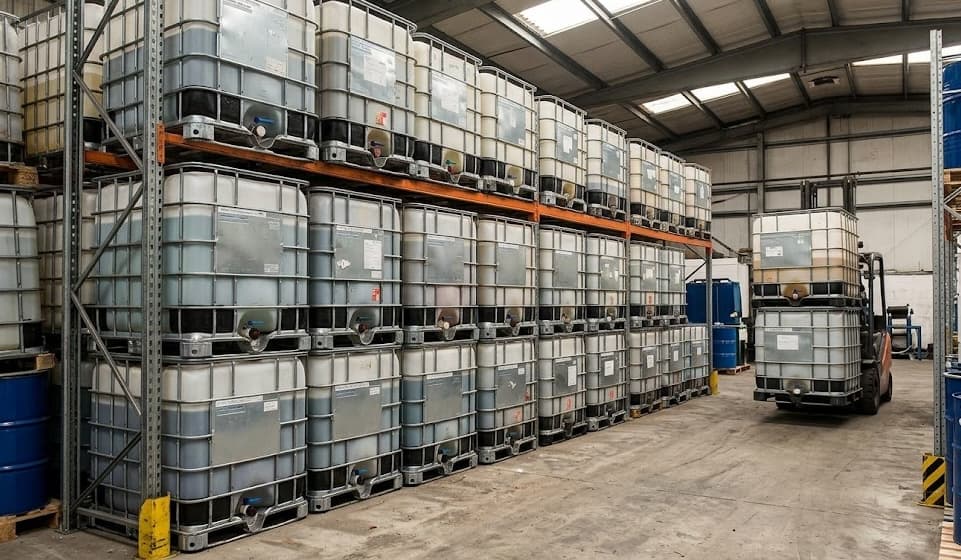
Sustainable IBC Solutions
Environmental Impact by the Numbers
Sustainability isn't a marketing slogan for us -- it's the entire reason our company exists. Here's the measurable difference we make every year.
Each IBC tote we recycle or recondition is one less container in a landfill. At over 100 lbs of mixed materials per unit, that adds up fast.
Manufacturing a new IBC tote from virgin materials produces roughly 60 lbs of CO2. Every reused tote eliminates that footprint entirely.
HDPE plastic takes up to 500 years to decompose in a landfill. We keep over 625 tons of it in productive use every year.
When a tote can't be reused whole, we disassemble it. The plastic, steel, and wood components are each sent to specialized recyclers. Almost nothing goes to waste.
The Global Plastic Crisis in Numbers
Industrial packaging is one of the least-discussed contributors to the global plastic waste problem. These numbers illustrate the scale of the crisis -- and why recycling IBC totes matters far more than most people realize.
The world produces approximately 380 million tons of plastic every year. Industrial containers -- including IBC totes -- account for a significant share of that total. Less than 10% of all plastic ever produced has been recycled.
An estimated 8 million tons of plastic waste enters the world's oceans annually. While consumer plastics get more attention, industrial packaging is a major contributor to both landfill overflow and waterway contamination.
Despite decades of recycling campaigns, 91% of all plastic produced globally is never recycled. It ends up in landfills, incinerators, or the natural environment. IBC totes are among the most recyclable industrial containers, yet the majority are still discarded.
The HDPE plastic used in IBC tote bottles takes more than 500 years to decompose in a landfill. That means every tote discarded today will outlast 20 generations of human beings before it breaks down.
Marine plastic pollution has reached 12.7 million metric tons per year. Microplastics from degrading industrial containers contaminate water supplies, soil, and food chains across the globe.
Plastic pollution causes an estimated $13 billion in economic damage to marine ecosystems every year. This figure includes costs to fishing, tourism, shipping, and cleanup operations -- but excludes the incalculable cost to biodiversity.
IBC totes represent a unique opportunity in the fight against plastic waste because they are among the most reusable industrial containers ever designed. Unlike single-use packaging that degrades after one cycle, a well-maintained IBC tote can be cleaned, reconditioned, and returned to service many times over. The materials are high-value and readily recyclable. The infrastructure to collect and process them already exists -- companies like ours. What's missing is awareness. Too many businesses still treat IBC totes as disposable, simply because they don't know there's a better option. That's what we're here to change.
Water Conservation at Our Facility
Cleaning IBC totes requires water -- but we are committed to using as little as possible and treating every drop responsibly. Here are the numbers behind our water stewardship program.
Our closed-loop water reclamation system captures, filters, and reuses 75% of the water used in our tote cleaning process, dramatically reducing our freshwater consumption compared to single-pass wash systems.
Through our water reclamation and efficiency programs, we save an estimated 1.2 million gallons of freshwater every year -- enough to fill nearly two Olympic-sized swimming pools.
Every drop of wastewater from our cleaning operations is treated to meet or exceed local discharge standards before it leaves our facility. We test regularly and maintain detailed treatment logs.
Since 2020, we have reduced our per-tote water consumption by 40% through equipment upgrades, process optimization, and investments in high-efficiency nozzle technology.
Closed-Loop Reclamation
Our water reclamation system captures wash water after each cleaning cycle, filters out contaminants through multi-stage filtration including sediment removal, chemical neutralization, and UV sterilization, then returns clean water to the wash system. This dramatically reduces our demand for municipal freshwater and minimizes our wastewater discharge volume.
Discharge Compliance
All wastewater that does leave our facility is treated to meet or exceed Metropolitan Water Reclamation District standards. We maintain continuous monitoring of pH levels, chemical oxygen demand, total suspended solids, and specific contaminant concentrations. Our discharge records are available for inspection and we welcome third-party audits of our water treatment processes.
Carbon Footprint: New Tote vs. Reconditioned Tote
We have broken down the carbon footprint of an IBC tote at every stage of its lifecycle -- from raw material extraction to delivery. The comparison between a brand-new tote and a reconditioned one speaks for itself.
Manufacturing a new IBC tote begins with extracting petroleum for HDPE plastic, mining iron ore for steel, and harvesting timber for the pallet. Reusing a tote eliminates all extraction-related emissions.
Blow-molding a new HDPE bottle requires heating plastic pellets to over 400 degrees F and shaping them under pressure. This energy-intensive process is entirely bypassed when a tote is reconditioned.
Welding and forming a new steel cage produces significant emissions. Reconditioning an existing cage requires only minor repairs -- straightening bent tubes, replacing a damaged weld, or applying rust treatment.
Assembling a new tote involves combining the bottle, cage, pallet, valve, and lid. Our reconditioning process replaces only worn components, using far less energy and generating fewer emissions.
New totes do not require cleaning. Our reconditioning process adds a cleaning step, but the emissions from hot water wash and sanitization are a fraction of the total savings achieved by reuse.
New totes are often shipped from overseas manufacturers. Our reconditioned totes are processed and delivered locally across the Midwest, significantly reducing transportation emissions.
The total lifecycle carbon footprint of a reconditioned IBC tote is approximately 83.5% lower than that of a brand-new container. Every tote we recondition eliminates roughly 50 lbs of CO2 emissions.
The Circular Economy for IBC Totes
The traditional lifecycle of an IBC tote is shockingly linear: manufacture, fill, ship, empty, discard. We replace that model with a circular one. Here is every stage of the circle -- and the role we play in keeping materials in productive use.
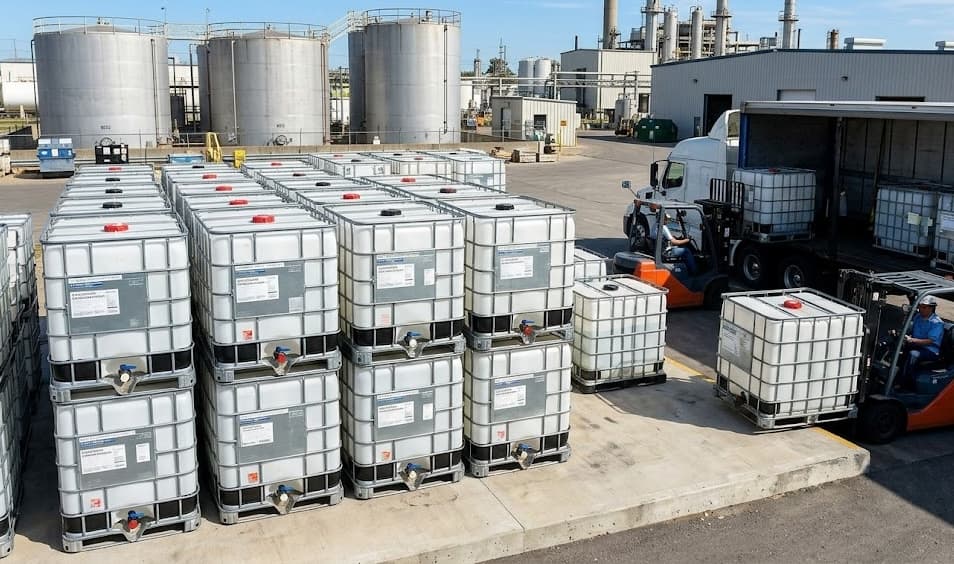
Closing the Loop on Container Waste
Our circular economy model ensures that every IBC tote we collect is either reconditioned for reuse or fully disassembled for material recovery. From our outdoor collection yard to our indoor cleaning bays, every step is designed to maximize the productive life of each container.
The result: 98% of all materials that enter our facility are recovered and returned to productive use. That means less plastic in landfills, fewer virgin resources extracted, and a cleaner future for everyone.
Manufacturing
New IBC totes are manufactured from HDPE plastic, galvanized steel, and wood. This initial production consumes virgin raw materials and generates the highest carbon footprint in the tote lifecycle.
First Use
The tote is filled with product -- chemicals, food ingredients, oils, solvents, water treatment compounds -- and shipped to a customer. The tote performs its primary function of safe bulk liquid transport.
Collection by IBC Recycling
Once emptied, the tote is collected by our fleet. We pick up from manufacturing plants, distribution centers, farms, and industrial facilities across the Midwest. This is where the linear model would send the tote to landfill.
Inspection & Grading
Every tote undergoes a multi-point inspection. We evaluate structural integrity, bottle condition, cage strength, valve function, and pallet stability. Totes are graded A, B, or C to determine their next path.
Cleaning & Reconditioning
Qualifying totes are cleaned using multi-stage hot water pressure washing, industry-appropriate detergents, and triple-rinse protocols. Components are repaired or replaced as needed. The tote is restored to like-new condition.
Resale & Reuse
Reconditioned totes are sold to businesses at 40-60% below new-tote pricing. The container enters service again -- potentially cycling through multiple uses over its extended lifetime.
End-of-Life Material Recovery
When a tote reaches the end of its structural life, we disassemble it completely. HDPE is ground into flake and pellet. Steel is baled for recyclers. Wood is chipped for landscaping. 98% of materials are recovered.
Return to Supply Chain
Recovered materials re-enter the manufacturing supply chain. HDPE becomes new plastic products. Steel is reforged. Wood becomes mulch or particle board. The circle is complete -- nothing is wasted.
In a linear economy, a tote is manufactured, used once, and discarded. In our circular model, a single tote can cycle through multiple uses before its materials are recovered and returned to the supply chain. This means fewer virgin resources extracted, less energy consumed, less carbon emitted, and less waste generated -- at every turn of the circle.
How IBC Tote Recycling Works
From pickup to return-to-service, every step in our process is designed to maximize reuse and minimize waste.
Collection & Intake
We pick up used IBC totes from manufacturers, distributors, farms, and industrial facilities across the Midwest. Our drivers follow DOT-compliant procedures for loading, securing, and transporting containers, including those that held hazardous materials. Every tote is logged into our tracking system the moment it arrives at our Elk Grove Village facility.
Inspection & Grading
Trained inspectors evaluate every tote for structural integrity, residual contents, container age, and overall condition. We check the HDPE bottle for cracks, warping, and UV degradation. We examine the steel cage for rust, dents, and weld failures. We inspect the pallet base for rot and breakage. Each tote receives a grade (A, B, or C) that determines its next path: reconditioning for resale, component recycling, or material recovery.
Cleaning & Reconditioning
Totes that pass inspection enter our multi-stage cleaning process. We use high-pressure hot water wash, specialized detergents appropriate for the previous contents, and triple-rinse protocols that meet FDA and EPA standards. Valves, gaskets, and lids are replaced as needed. The steel cage is straightened or repaired, and the entire unit is re-inspected before it earns our quality seal. Food-grade totes undergo additional sanitization and testing.
Resale or Material Recovery
Reconditioned totes are sold to businesses that need reliable bulk containers at a fraction of new-tote pricing. Totes that can't be reconditioned are carefully disassembled: HDPE bottles are ground into flake and pellet for plastics manufacturers, steel cages are baled and sent to steel recyclers, and wood pallets are repaired or chipped for landscaping material. We track every component to ensure maximum material recovery.
Return to Service
Whether as a whole reconditioned tote or as recycled raw materials, every container that enters our facility returns to productive use. This closes the loop on the circular economy for IBC totes -- reducing the demand for virgin materials, cutting manufacturing emissions, and keeping industrial containers where they belong: in service, not in landfills.
8 Environmental Pledges We Stand Behind
These are not vague aspirations. Each pledge has a specific target, a timeline, and measurable progress. We hold ourselves accountable to every one.
Zero Landfill by 2027
We are committed to achieving a 100% material recovery rate by 2027. Currently at 98%, we are investing in advanced sorting technology and new recycling partnerships to ensure that absolutely no IBC tote material reaches a landfill from our operations.
Carbon-Neutral Operations by 2028
We are actively working toward carbon-neutral facility operations by 2028. This includes transitioning to renewable energy sources, optimizing our fleet for fuel efficiency, and purchasing verified carbon offsets for emissions we cannot yet eliminate.
50% Water Reduction by 2027
Building on our current 40% reduction in per-tote water consumption, we are targeting a 50% total reduction by 2027 through continued investment in closed-loop reclamation, high-efficiency nozzles, and advanced filtration systems.
Electric Fleet Transition
We are exploring electric and alternative-fuel vehicles for our short-haul pickup and delivery routes across Chicagoland. Our goal is to transition 30% of our local fleet to electric by 2028, with full electrification of local routes by 2030.
Biodegradable Cleaning Agents
We are committed to transitioning 100% of our cleaning agents to biodegradable, plant-based formulations by 2027. We are currently testing several promising alternatives that deliver equal or superior cleaning performance with reduced environmental impact.
Supply Chain Transparency Reporting
Beginning in 2026, every customer will have access to a personalized sustainability dashboard showing the number of totes they have diverted from landfills, the CO2 they have offset, and their total environmental impact through our partnership.
Community Environmental Education
We pledge to partner with at least three local schools and community organizations each year to educate the next generation about circular economy principles, industrial recycling, and the importance of keeping plastic out of landfills and waterways.
Annual Sustainability Audit
We commit to conducting an annual third-party sustainability audit of our operations and publishing the results publicly. Full transparency in our environmental performance holds us accountable and gives our customers confidence in our claims.
Year-Over-Year Environmental Impact
Our environmental impact has grown every year since we began tracking it. Here is a transparent look at our progress -- the numbers do not lie.
| Year | Totes Processed | CO2 Saved | Plastic Diverted | Water Reuse | Recovery Rate |
|---|---|---|---|---|---|
| 2019 | 6,800 | 185 tons | 340 tons | 45% | 92% |
| 2020 | 7,400 | 200 tons | 370 tons | 52% | 93% |
| 2021 | 8,900 | 240 tons | 445 tons | 58% | 95% |
| 2022 | 10,200 | 275 tons | 510 tons | 65% | 96% |
| 2023 | 11,600 | 315 tons | 580 tons | 70% | 97% |
| 2024 | 12,500 | 340 tons | 625 tons | 75% | 98% |
Data reflects operations at our Elk Grove Village, IL facility (2645 American Ln, Elk Grove Village, IL 60007). CO2 savings calculated based on avoided emissions from virgin tote manufacturing. Water reuse percentage reflects closed-loop reclamation rate. Recovery rate represents the percentage of total material weight diverted from landfill.
Recycled vs. New Manufacturing: The Full Picture
When you choose a reconditioned IBC tote over a brand-new one, the environmental and economic benefits are substantial across every measurable dimension. Here is a detailed comparison.
| Metric | New Manufacturing | Recycled / Reconditioned | Savings |
|---|---|---|---|
| Energy Consumption | 100% | 17% | 83% |
| Carbon Emissions | 60 lbs CO2/tote | 9.9 lbs CO2/tote | 83.5% |
| Water Usage | 120 gallons/tote | 35 gallons/tote | 71% |
| Raw Material Extraction | 110 lbs virgin material | 5 lbs replacement parts | 95.5% |
| Landfill Waste Generated | 8 lbs packaging/scrap | 2 lbs (non-recoverable) | 75% |
| Transportation Emissions | 10.2 lbs CO2 (overseas) | 4.1 lbs CO2 (local) | 60% |
| Chemical Pollutants Released | High (molding, welding, coating) | Low (cleaning agents only) | ~80% |
| Cost to Customer | $200-$350/tote | $80-$180/tote | 40-60% |
| Lead Time | 4-8 weeks | 24-48 hours | N/A |
| End-of-Life Recovery | ~15% industry average | 98% (IBC Recycling) | N/A |
These figures represent industry-wide averages for new IBC tote manufacturing compared to our reconditioning process. Actual savings vary depending on tote condition, previous contents, transportation distance, and specific reconditioning requirements. Energy, water, and emissions data are based on lifecycle assessment methodologies consistent with ISO 14040/14044 standards.
What We Commit To Every Day
These are not aspirational goals -- they are active practices baked into our daily operations at our Elk Grove Village facility.
Zero-Landfill Operations
We are committed to sending zero IBC tote material to landfills. Every component of every container we process is either reused, recycled, or recovered. Our current material recovery rate exceeds 98%, and we continuously invest in processes and partnerships that push that number closer to 100%.
Carbon Footprint Reduction
We optimize our truck routes to minimize fuel consumption and emissions. We consolidate pickups and deliveries whenever possible, maintain our fleet to the highest efficiency standards, and are actively exploring electric and alternative-fuel vehicles for our short-haul operations.
Water Stewardship
Our cleaning process uses water responsibly. We employ closed-loop water reclamation systems that capture, filter, and reuse wash water, significantly reducing our consumption compared to single-pass cleaning methods. All wastewater is treated to meet local discharge standards before it leaves our facility.
Chemical Safety
We follow strict protocols for identifying, handling, and neutralizing residual chemicals in used IBC totes. Our cleaning agents are chosen for effectiveness and environmental safety. We maintain detailed records of every container's previous contents and cleaning procedure, ensuring full traceability and compliance with EPA and OSHA regulations.
Supply Chain Transparency
We track every tote from the moment it enters our facility to the moment it leaves -- whether as a reconditioned container or as recycled material. Our customers receive detailed documentation including container history, cleaning records, and grading criteria. We believe transparency builds trust and accountability.
Continuous Innovation
We invest a portion of our revenue into researching better cleaning methods, more efficient logistics, and new ways to recover value from end-of-life containers. We actively seek partnerships with environmental organizations, waste management innovators, and academic researchers working on circular economy solutions for industrial packaging.
Sustainability Partnerships
We cannot build a circular economy alone. These partnerships are the backbone of our ability to recover, recycle, and reuse every material that passes through our facility.
Regional Plastics Recyclers
We partner with HDPE recycling facilities across the Midwest to ensure that end-of-life tote bottles are processed into high-quality recycled resin. These partnerships guarantee that our plastic stays in the manufacturing supply chain rather than ending up in a landfill.
Steel Recycling Network
Our steel cage recycling partners operate modern electric arc furnaces that transform scrap steel into new products with a fraction of the energy and emissions required for virgin steel production. Every cage we recycle returns to the steel supply chain.
Local Wood Recyclers
Pallet bases that cannot be repaired are sent to local wood recyclers who chip them into landscaping mulch, animal bedding, or particle board feedstock. Even the wood component of an IBC tote finds a productive second life.
Environmental Nonprofits
We support and collaborate with environmental nonprofit organizations focused on reducing industrial waste, promoting circular economy practices, and advocating for stronger recycling infrastructure in the Midwest.
Municipal Waste Reduction Programs
We work with municipalities across Chicagoland and the broader Midwest on industrial waste reduction initiatives. Our expertise in IBC tote recycling helps communities develop effective programs for managing industrial container waste streams.
Industry Trade Associations
We are active members of industry groups that set standards for container reuse and recycling. By participating in these organizations, we help shape best practices that raise the bar for the entire IBC tote industry.
Our Sustainability Roadmap
We have set ambitious but achievable goals for the years ahead. Here is our public roadmap -- transparent, specific, and accountable.
- Launch customer-facing sustainability dashboard with real-time impact tracking
- Begin pilot program for electric delivery vehicles on Chicagoland routes
- Achieve 99% material recovery rate
- Transition 50% of cleaning agents to biodegradable formulations
- Reach 100% material recovery rate -- true zero-landfill operations
- Reduce per-tote water consumption by 50% compared to 2020 baseline
- Complete transition to 100% biodegradable cleaning agents
- Expand pickup service area to cover 6 Midwest states
- Achieve carbon-neutral facility operations through renewables and offsets
- Transition 30% of local fleet to electric vehicles
- Process 20,000+ totes annually
- Publish first annual public sustainability report
- Full electrification of all local pickup and delivery routes
- Process 30,000+ totes annually across expanded Midwest facilities
- Establish IBC tote recycling education program in 10+ school districts
- Set industry benchmark for sustainable container reconditioning
A Message From Our Leadership
When we started IBC Recycling Chicago, the motivation was simple: we saw thousands of perfectly good industrial containers being thrown away every year, and we knew there had to be a better way. Every IBC tote that ends up in a landfill represents a failure of imagination -- because these containers are engineered to last for years and built from materials that are fully recyclable.
Our sustainability mission is not a side project or a PR initiative. It is the core purpose of this company. Every decision we make -- from the cleaning chemicals we choose to the truck routes we plan to the partnerships we build -- is evaluated through the lens of environmental impact. We ask ourselves: does this reduce waste? Does this keep materials in productive use? Does this lower our carbon footprint?
We are proud of the progress we have made -- 12,500 totes processed annually, 340 tons of CO2 saved, 625 tons of plastic diverted from landfills, and a 98% material recovery rate. But we are not satisfied. Our goal is 100% recovery, carbon-neutral operations, and a service area that covers every corner of the Midwest. We will not stop until every IBC tote in this region has a path back to productive use instead of a path to a landfill.
To our customers: thank you for choosing to recycle instead of discard. Every tote you send our way is a vote for a more sustainable future. To our partners: thank you for sharing our vision and making our circular economy model possible. And to anyone reading this who is considering what to do with their used IBC totes -- give us a call. We will make recycling the easiest, most affordable, and most responsible choice you can make.
The IBC Recycling Chicago Leadership Team
2645 American Ln, Elk Grove Village, IL 60007
Partner With Us for a Sustainable Future
The goal is simple: make recycling IBC totes so easy, so affordable, and so transparent that no business in the Midwest would ever consider sending a container to a landfill again. Whether you have 10 totes or 10,000, we have the capacity, the expertise, and the commitment to handle them responsibly.
Every tote you recycle with us is a measurable contribution to reducing plastic waste, conserving water, and cutting carbon emissions. Let us show you exactly what your environmental impact looks like when you choose IBC Recycling Chicago.